Have you noticed a loved one having trouble finding words, remembering names, or following conversations?
Are you wondering whether these changes could be aphasia, dementia, or something else entirely?
Or are you trying to understand the difference so you can help them get the right support?
If so, you’re not alone.
Aphasia and dementia can sometimes look similar, especially when communication becomes harder.
But they are not the same condition, and understanding the difference matters.
Aphasia primarily affects language, often after a stroke or brain injury.
Dementia affects broader thinking skills, such as memory, reasoning, attention, problem solving, and other executive function skills.
In some cases, a person may even experience both.
In this article, we’ll break down what aphasia is, what dementia is, and how the two conditions differ.
We’ll also look at Primary Progressive Aphasia, whether someone can have both aphasia and dementia, why an accurate diagnosis is important, and how speech therapy can help support communication, confidence, and connection.
What Is Aphasia?
Aphasia is a language disorder that affects how someone speaks, understands, reads, or writes.
According to a 2024 article by Le et al., it occurs in approximately 1 out of 272 Americans.
Aphasia originates in the brain, usually after damage to areas responsible for language.
For most people, these language areas are located in the left hemisphere of the brain.
When these areas are damaged, a person may have difficulty speaking, understanding, reading, or writing.
RELATED ARTICLE: Speech Therapy for Aphasia: Causes, Symptoms, and How It Helps Recovery
Causes of Aphasia
Strokes are the most common cause of aphasia.
A 2022 article by Grönberg et al. found that aphasia was present in approximately 30% of ischemic stroke patients at stroke onset.
These are potentially life-threatening medical emergencies that interfere with your brain’s blood flow.
This process causes damage by depriving your brain of oxygen.
Some other common causes of aphasia include:
- Traumatic brain injuries
- Brain tumors
- Infections, such as meningitis
- Neurodegenerative diseases, such as Primary Progressive Aphasia
It’s important to note that aphasia doesn’t impair your intelligence.
A person with aphasia may still know what they want to say but have difficulty expressing it clearly.
Types of Aphasia
Not everyone with aphasia experiences the exact same symptoms and challenges.
There are several kinds of aphasia, each with different speech and communication symptoms.
Examples include:
- Broca’s aphasia, which causes difficulty forming complete sentences
- Wernicke’s aphasia, which causes fluent but nonsensical speech as well as trouble understanding others
- Global aphasia, which causes severe impairment in both language comprehension and expression
- Primary Progressive Aphasia (PPA), which causes symptoms that gradually worsen over time
What Is Dementia?
Dementia is not a specific disease.
Rather, it’s a general term for a decline in cognitive function that interferes with daily life.
It affects memory, reasoning, attention, language, and problem solving.
RELATED ARTICLE: Speech Therapy for Dementia: How It Helps Communication and Quality of Life
Types of Dementia
Like aphasia, dementia has several different subtypes with varying degrees of symptoms and impairment.
Examples include:
- Alzheimer’s disease
- Vascular dementia
- Lewy body dementia
- Frontotemporal dementia
- Mixed dementia
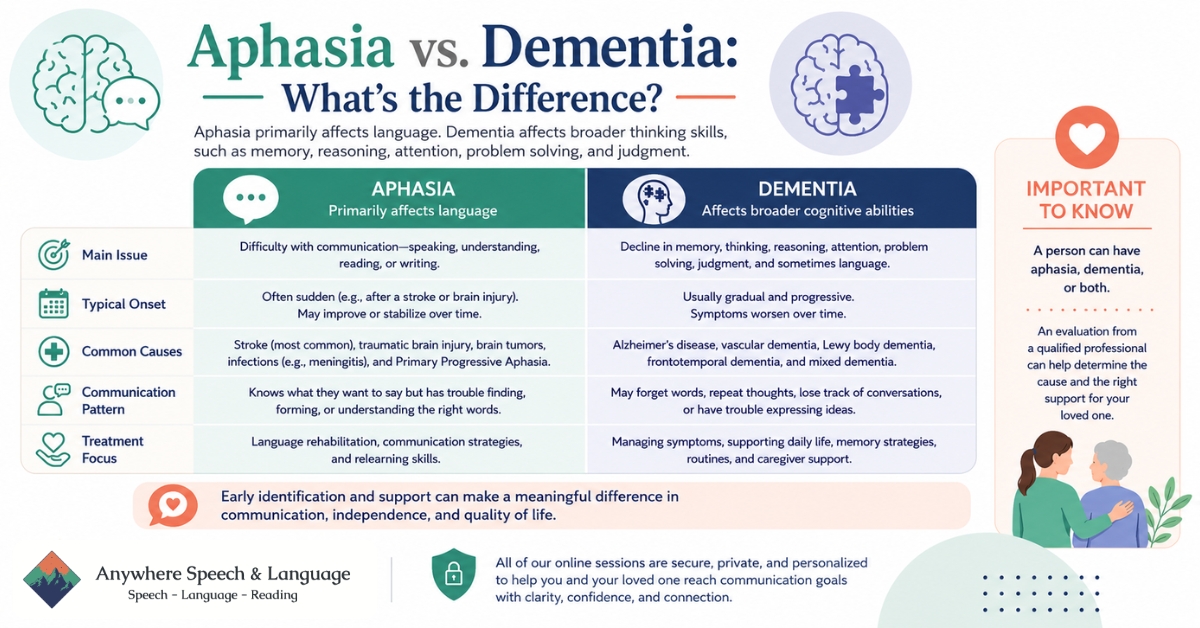
Unlike aphasia, which primarily affects language, dementia typically involves broader cognitive decline.
In some types, memory loss appears early, while others may begin with changes in language, behavior, judgment, or personality.
Key Differences Between Aphasia and Dementia
At first glance, you might think that these two conditions look and act exactly alike.
However, there are several key differences that medical professionals look for when making a diagnosis.
First and foremost, these two conditions have entirely different impacts on the brain.
Aphasia primarily affects language skills, whereas dementia can cause broader cognitive impairments involving memory, thinking, and judgment.
They also differ in their causes.
Aphasia most often occurs following some type of brain damage whereas dementia occurs due to progressive brain disease.
Disease progression is another way to determine whether your loved one is living with aphasia or dementia.
Aphasia caused by a stroke or brain injury often has a sudden onset and may improve or stabilize over time.
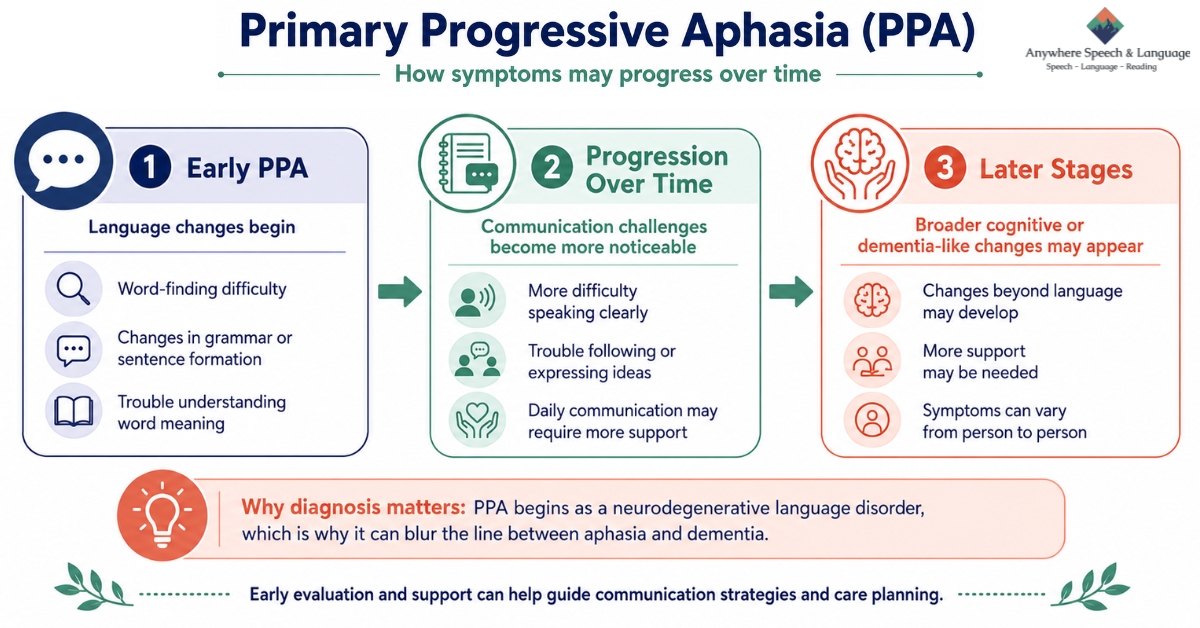
Primary Progressive Aphasia is different because it develops gradually and worsens over time.
Dementia also typically involves gradual, progressive decline, though symptoms may begin with memory, language, behavior, judgment, or other cognitive changes depending on the type.
Finally, these two conditions can lead to different communication challenges.
Someone with aphasia may know what they want to say but have difficulty finding or forming the words.
Conversely, someone with dementia often forgets the words they want to say, repeats their thoughts, or rambles.
What Is Primary Progressive Aphasia (PPA)?
Now that we’ve discussed the differences between aphasia and dementia, let’s turn our attention to Primary Progressive Aphasia (PPA).
Here’s where things get more complex.
PPA is a neurodegenerative language disorder often associated with frontotemporal dementia that primarily affects communication.
Over time, people with PPA may develop broader symptoms seen in other types of dementia.
There are three subtypes of PPA:
- Nonfluent/Agrammatic PPA, which causes trouble forming grammatically correct sentences
- Semantic PPA, which causes difficulty understanding word meanings
- Logopenic PPA, which causes difficulty finding words but usually doesn’t significantly impact grammar or word comprehension early on
PPA blurs the line between aphasia and dementia.
But early on, it behaves more like classic aphasia and causes language loss instead of memory impairments.
Can a Person Have Both Aphasia and Dementia?
This is one of the most common questions surrounding aphasia and dementia.
The answer is simple: it’s entirely possible for someone to have both conditions.
This is where an accurate diagnosis becomes crucial.
A person with dementia may develop aphasia-like symptoms as the disease progresses.
Similarly, a person with aphasia due to a stroke may later develop dementia unrelated to the original brain injury.
The sequence and cause of symptoms help professionals determine which condition is at play, and which speech-language therapy services will help most.
Real-Life Examples of Aphasia and Dementia
Let’s look at two different scenarios to illustrate the difference.
Case 1: Stroke-Induced Aphasia
Maria, age 72, had a stroke that affected the left hemisphere of her brain.
She knows what she wants to say but has trouble getting the words out.
Her memory and thinking skills are intact, but conversations are frustrating.
She receives speech therapy to rebuild her language pathways and improves over time.
Case 2: Alzheimer’s Disease
James, age 76, starts forgetting conversations, misplacing items, and repeating stories.
Later, he begins using vague language (“that thing” instead of the right word) and gets confused in familiar places.
His language challenges are part of a broader cognitive decline.
His doctor diagnoses him with Alzheimer’s and he enters a cognitive care plan that includes memory and language support.
Why Is an Accurate Diagnosis So Important?
Mislabeling dementia as aphasia, or vice versa, can lead to the wrong type of treatment.
Aphasia is often treatable, especially when it develops following a stroke or injury.
Conversely, dementia requires long-term care planning and supportive therapies focused on function and quality of life.
Speech-language pathologists (SLPs) play a key role in assessing language vs. cognitive deficits and tailoring therapy accordingly.
How Does Speech Therapy Help with Aphasia and Dementia?
So, how does speech therapy support these different conditions?
Whether someone has aphasia, dementia, or both, speech-language therapy can improve quality of life.
For adults experiencing changes in speech, language, memory, or communication, adult speech therapy can provide practical strategies tailored to their diagnosis, goals, and daily communication needs.
For Aphasia, a speech therapist can help with:
- Rebuilding language pathways
- Improving word retrieval and sentence formation
- Teaching alternative communication strategies (e.g., gestures, writing)
- Educating families on how to support communication
For Dementia, a speech therapist can help with:
- Memory strategies and routines
- Visual aids and environmental modifications
- Training caregivers on supportive communication
- Maintaining skills for as long as possible
Because communication changes can affect the whole family, caregiver support matters too.
Families may also benefit from learning about aphasia caregiver self-care, especially when recovery feels stressful, overwhelming, or emotionally draining.
In both cases, therapy is not just about words, it’s about restoring confidence, connection, and independence.

When Should I Seek Help for Aphasia and/or Dementia?
If you or someone you care about is:
- Facing challenges with word retrieval or following conversations
- Forgetting familiar names or places
- Repeating stories or losing track of thoughts
- Having trouble reading or writing
- Showing sudden or gradual changes in communication
If communication changes happen suddenly, especially alongside facial drooping, arm weakness, confusion, severe headache, vision changes, dizziness, or balance problems, call 911 right away.
Sudden speech or language changes may be a sign of stroke or another medical emergency.
If symptoms are gradual or ongoing, it’s time to seek an evaluation.
Early support makes a big difference, especially with language and memory impairments.
Get the Right Support for Aphasia, Dementia, or Both
Aphasia and dementia can look similar at first, especially when word-finding, memory, or conversation becomes harder, but understanding the difference can help families seek the right kind of support.
An accurate evaluation can clarify whether communication changes are related primarily to language, broader cognitive decline, or both.
With the right speech therapy approach, individuals can build communication strategies, reduce frustration, and stay connected with the people around them.
Support can also help caregivers better understand what their loved one is experiencing and how to communicate in more helpful, compassionate ways.
At Anywhere Speech and Language Therapy, we provide personalized online speech therapy for adults and families across many states within the U.S., making expert support accessible wherever you are.
You can also learn more about how online speech therapy works before getting started.
Our speech-language pathologists work with adults and caregivers to create practical communication strategies that support daily life, connection, and quality of life.
If you or a loved one is experiencing changes in speech, language, memory, or communication, schedule an evaluation today and take the first step toward greater clarity, confidence, and connection.